
Class 10 Science Chapter 8
Heredity
Exercise Solution
Chapter 8
Heredity
Intext Questions (page no. 129)
If a trait A exists in 10% of a population of an asexually reproducing species and a trait B exists in 60% of the same population, which trait is likely to have arisen earlier?
Ans. Trait B, because it is present in more members of the population. It is likely to have arisen earlier and has now spread to 60% of the population. Trait A is new and has spread to only 10% of the population.
How does the creation of variations in a species promote survival?
Ans. The variations provide stability to the population of various species by preventing them from getting wiped out during adverse conditions.
— The natural environment also changes and variations in species which become suited to the environment help it to survive.
— For example, Bacteria variants which can withstand (tolerate) heat will survive better in a heat wave than variant which cannot tolerate heat wave.
— Thus variations in a population of a species help in survival of a species.
Intext Questions ( page no. 133)
How do Mendel’s experiments show that traits may be dominant or recessive?
Ans. Mendel carried out monohybrid cross between a tall pea plant and a dwarf pea plant and get following result.
— When Mendel carried out a cross between Tall plant (TT) with dwarf plant (tt), In first generation, the progeny were tall, there was no medium height or durf plant.
— This meant that only one of the parental traits was seen, not some mixture of the two.
— When F1 generation plant are self-pollinated the progeny of F2 generation plants are not tall, 25% of plants are Dwarf (Short) and 75% are tall.
— This indicates that both tallness and shortness traits were inherited in F1 plants, but only the tallness traits was expressed.
— This indicates that two copies of genes may be identical, or may be different, depending on the parentage.
— In this experiment both ‘TT’ and ‘Tt’ are tall plant while only ‘tt’ is a short plant.
— In ‘Tt’, ‘T’ is expressed and ‘t’ is suppressed. Hence the characterers ‘T’ is the dominant trait and ‘t’ is the recessive trait.
2. How do Mendel’s experiments show that traits are inherited independently?
Ans. Mendel carried out dihybrid crosses by crossing two pea plant of two different characters.
— For example, he crossed a pea plant having yellow and round seeds with another pea plant bearing green and wrinkled seeds.
— The F1 generation contains 100% hybrid plants When RRyy crosses with rryy, all offspring plants are RrYy with round and yellow seeds in the first generation.
— Therefore, the round and yellow seeds are the dominant characters.
— In the F2 generation, he obtained pea plants with two parental and two recombinant phenotypes as yellow-round and green wrinkled (parental) and yellow wrinkled and green round (recombinant).
— This shows that genes independently inherited.
3. A man with blood group A marries a woman with blood group O and their daughter has blood group O. Is this information enough to tell you which of the traits – blood group A or O is dominant? Why or why not?
Ans. This information is not enough. This is because each individual carries two genes. The recessive traits can occur only when whose genes are similar. If blood group A is dominand and O is recessive, then daughter can have blood group O only. When both recessive genes occurs together in mother and father has one gene of O and other of A.
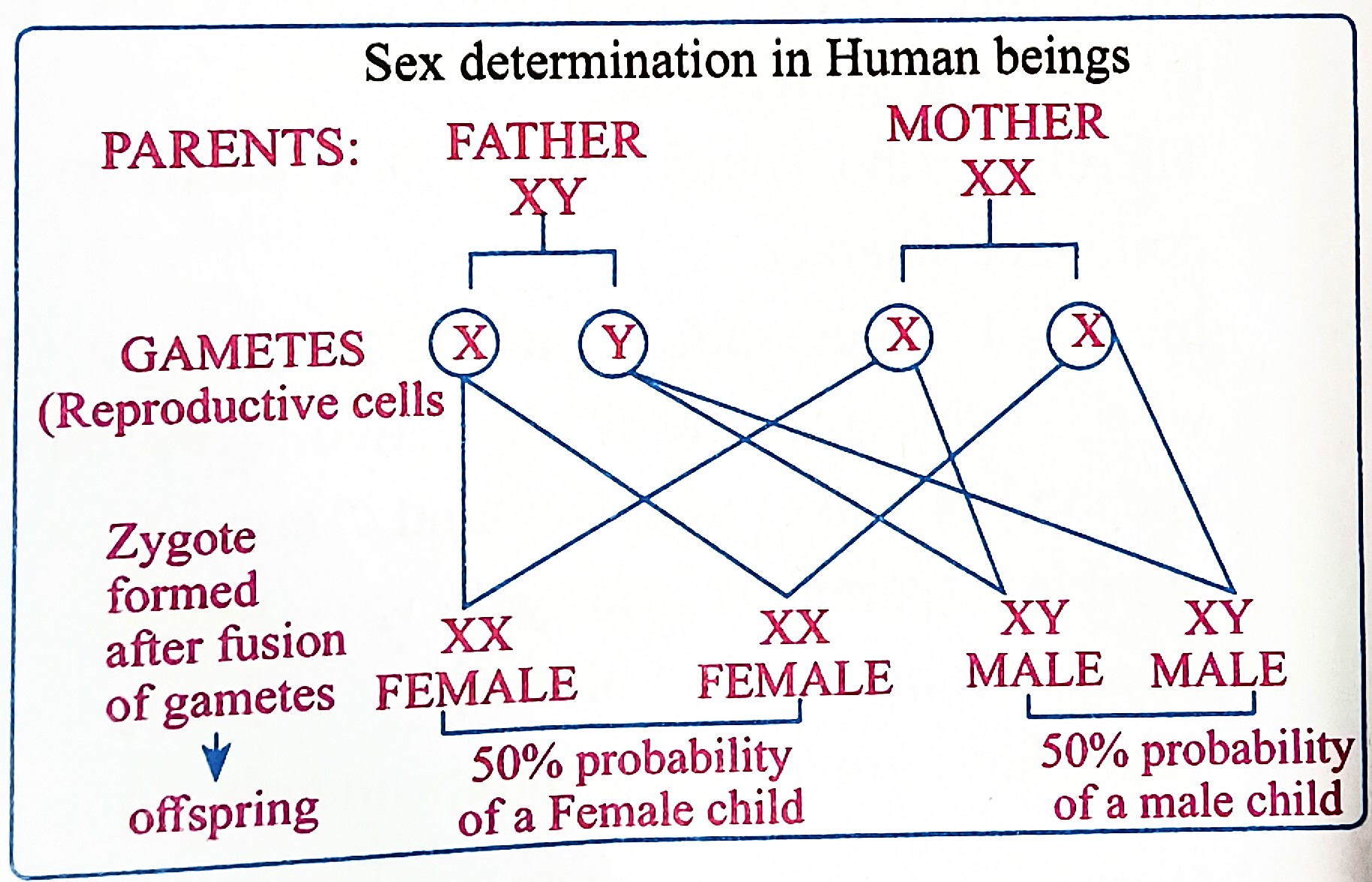
How is the sex of the child determined in human beings?
Ans. In human beings 23 pairs of In human beings there chromonsome, out of them 22 pairs are same but one pair, called the sex chromosome is odd & not always being a perfect pair.
— Women have a both called X-chromosome but men have one which is a normal-sized X while the other is a short one called Y.
— So, women are XX while men are XY.
— Thus, the sex of the children will be determined by they inherit from their father.
— A child who inherits an X-chromosome from her father will be a girl, and one who inherits a Y-chromosome from him will be a boy.
Exercise:-
1. A Mendelian experiment consisted of breeding tall pea plants bearing violet flowers with short pea plants bearing white flowers. The progeny all bore violet flowers, but almost half of them were short. This suggests that the genetic make-up of the tall parent can be depicted as
(a) TTWW (b) TTww (c) TtWW (d) TtWw
Ans. (c) TtWW
A study found that children with light-coloured eyes are likely to have parents with light-coloured eyes. On this basis, can we say anything about whether the light eye colour trait is dominant or recessive? Why or why not?
Ans. This information is not complete. On the basis of this, it cannot be decided light colour trait is dominant or recessive. So it cannot be said until one does not know the nature of this trait in the parents.
Outline a project which aims to find the dominant coat colour in dogs.
Ans. Dogs have different coats in order to find dominant coat colour in dogs. Select female dog having white colour and male dog having black colour.
— Cross the homozygous female (WW) and homozygous male (ww) and observe the coat colour in dog progeny.
— If all dog progeny have white colour, this means the white colour (WW) will be dominant coat colour in dogs and if progeny will have black colour then black will be dominant coat colour.
How is the equal genetic contribution of male and female parents ensured in the progeny?
Ans. In human beings there are 23 pairs of chromones out of them 22 pairs are same in male and female. But one pair called the sex-chromosome is odd and not always being a perfect pair.
— Women have a perfect pair of sex-chromosomes both called X.
— Men have one normal-size X, while the other is a short one called Y.
— so women are XX and male are XY.
— During the process of fertilization, a haploid sperm fuses with a haploid ovum to produce a disploid zygote.
— Zygote receives equal amount of genetic material from each parent and thus, retains the diploid nature of fertilization.